For Communities & Clinics
Structured Memory Engagement
for Every Setting
From senior living and memory care to stroke rehabilitation and neuro recovery — NeuroMotive delivers personalized reminiscence therapy that drives measurable cognitive engagement.
31–84%
Documented service reimbursement increase at partner facilities
0.76–0.91
Effect size for emotional improvement (>0.8 considered large) — UC San Diego study
< 30 min
Average facility onboarding time
100%
HIPAA-compliant — BAA included with every contract
AI-Driven
Cognitive exercises mapped to OT & SLP billing codes
Built for two distinct settings.
One platform.
Senior Living & Memory Care
Elevate programming.
Strengthen family ties.
Integrate personalized reminiscence sessions into activity calendars and restorative therapy plans. Give families a role in care — and give residents something deeply familiar in every session.
- Assisted living & independent living
- Memory care & dementia programming
- Skilled nursing facilities
- Activity and restorative therapy teams
Stroke & Neuro Rehabilitation
Stimulate recall.
Support language recovery.
Personalized reminiscence content activates memory pathways that clinical stimuli alone cannot reach. Familiar photos and voices engage patients where they are — supporting speech, cognition, and emotional response.
- Stroke recovery & aphasia rehabilitation
- Traumatic brain injury (TBI) recovery
- Neurological rehabilitation programs
- PT, OT, and speech therapy integration
- Three tiers of AI-powered cognitive exercises — from simple recognition for advanced dementia to active scene description and word association for stroke recovery and speech therapy
- Voice-to-text input so staff can record resident responses without typing
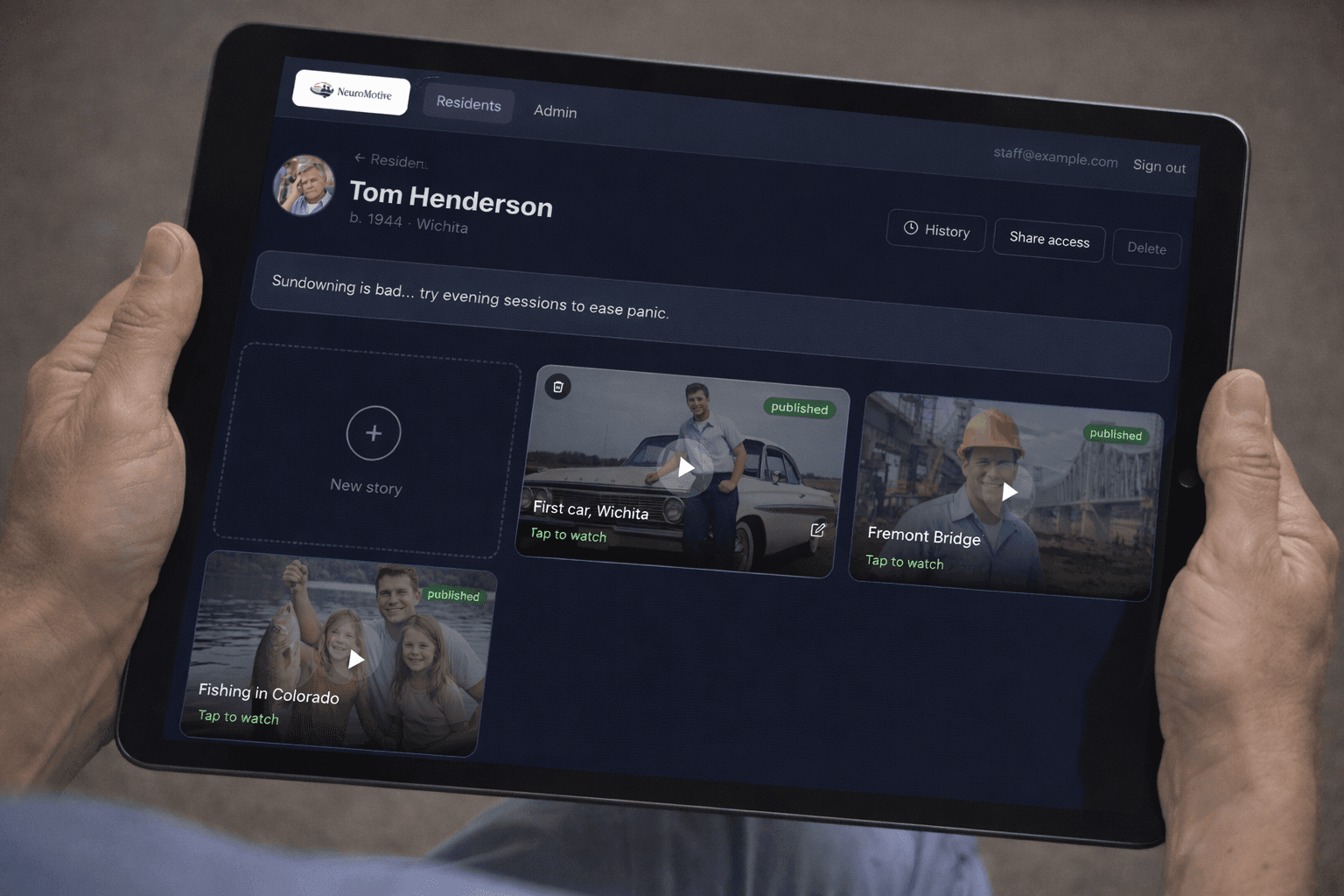
Each resident's own life, ready to play — stories built from family photos and voices, organized in a calm one-tap interface.
Generic activities produce generic results. NeuroMotive delivers structured, individualized reminiscence experiences powered by family-provided content and guided by cognitive engagement principles.
Our platform integrates into your existing activity programming, restorative therapy plans, and family engagement initiatives — without increasing operational burden.
Families contribute the content. Your team delivers the experience.
This is not passive entertainment. It is structured, memory-driven engagement that supports dignity, identity, and participation.
Why NeuroMotive
What it does for your facility
🧘
Calmer Residents, Better Participation
Familiar faces, voices, and memories have a measurable calming effect. Residents who arrive at therapy sessions settled and engaged complete more billable events.
📈
Stronger Documented Service Reimbursement
Active responses during sessions directly support MDS documentation and justify higher PDPM levels. Partner facilities report 31–84% improvement.
📋
Built-In Clinical Documentation
AI-generated clinical narratives, cognitive exercise results, daily mood journal (MDS Section D), HCPCS billing code suggestions, ICD-10 tracking, and auditable PDF reports.
🏥
Zero Added Staff Burden
Families upload content and record voices remotely. Sessions slot into existing schedules without adding FTEs.
👨👩👧
Family Engagement That Shows in Surveys
When families participate in care — even from a distance — satisfaction scores improve. Stronger family connection is visible to surveyors.
💰
More Reimbursable Events Per Resident
Mood improvement drives participation; participation drives documentation; documentation drives revenue.
🧠
Evidence-Informed for Complex Residents
Designed for dementia, post-stroke, aphasia, TBI, and neuro recovery — populations where generic activities fall flat.
🤖
AI Cognitive Games That Bill
Three tiers of personalized exercises that map to 97129/97130 (OT) and 92507 (SLP) billing codes. Turning engagement into documented, reimbursable events.
🎙️
Voice-to-Text Documentation
Clinicians dictate notes using voice-to-text. No typing on tablets — capture observations in real time.
For Your Team
What's in it for the people
championing it.
🎨
Activities directors
See which residents light up, which topics shut them down, and which themes pull a quiet room into conversation. Programming stops being guesswork — and the engagement data flows straight into care plans and family conversations.
📣
Sales & marketing
A real, screen-worthy moment families remember from the tour — something nobody down the street can show. Turns the differentiator into something families feel, not just read on a brochure.
🏛️
Executive director / administrator
One platform that protects star ratings and survey scores, gives staff a non-pharmacological calming tool, hands sales a story families remember from the tour, and keeps the documentation behind reimbursement clean.
🩺
Director of nursing
Calmer residents complete more therapy events — and the documentation generated lifts what the facility captures, every session. Clinically validated to calm anxiety without adding to the med pass, the cart, or staff workload.
💪
Therapy / rehab lead
More reimbursable events per resident — sessions warm up engagement so therapy actually happens, and AI-generated documentation backs every billable code at submission. Clinically validated, no extra burden on your team.
Documentation That Drives Reimbursement
Better engagement in.
Stronger documentation out.
Automatic Clinical Documentation
AI-generated clinical narratives, mood tracking, engagement scores, and cognitive exercise results — structured and ready for billing audits.
Billing Code Suggestions
Every report includes suggested HCPCS codes with rationale — 97129/97130, 92507, 97530, and more. Your therapists review and submit.
More Reimbursable Events
Calmer, more engaged residents complete more therapy sessions and generate stronger participation data — directly supporting the events your facility can capture.
PDPM Support
- Mood and engagement data supports MDS Section D & E
- Documented non-pharmacological behavioral interventions
- Functional engagement evidence for Section GG
Billing Codes Generated
- 97129/97130 — Cognitive function intervention (OT)
- 92507 — Speech/language treatment (SLP)
- 97530 — Therapeutic activities
In Practice
What communities notice
in the first weeks.
Residents who rarely engage in group programming begin responding to content built from their own lives. A familiar photo prompts a name. A family voice prompts a sentence. Recognition replaces withdrawal.
Staff report shorter ramp times to meaningful interaction — sessions start producing engagement within the first few uses, not after weeks of trial and error with generic content.
Residents who stopped participating in group activities will often point, speak, and recall when they see their own familiar faces and hear their own family's voices.
Families notice too. They report feeling more connected to the care process — and more confident that their loved one's identity is being honored, not just managed.
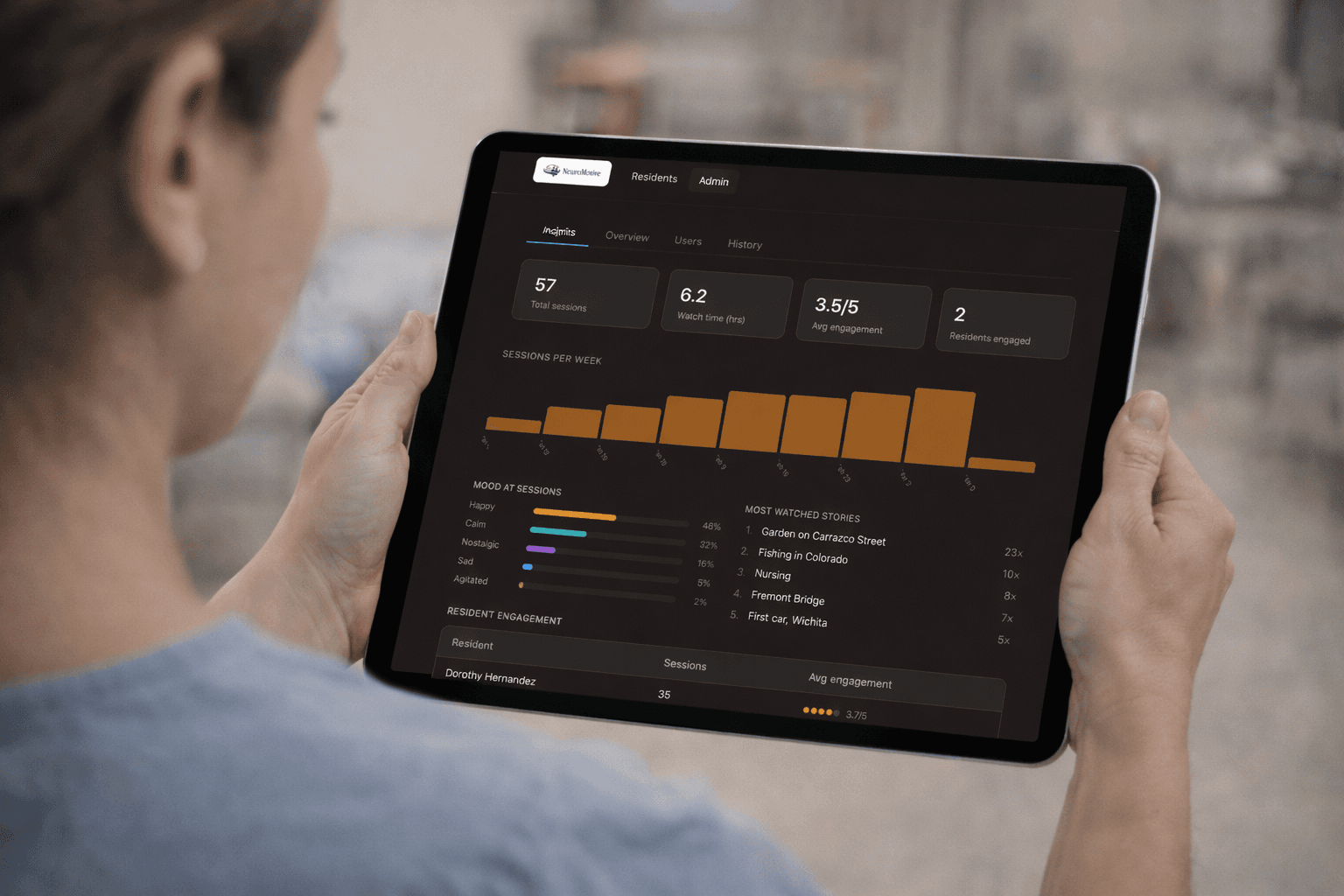
What facilities typically see
- Increased verbal engagement during sessions
- Improved mood and emotional responsiveness
- Reduced agitation around session times
- Stronger family satisfaction and participation
- Documented engagement data for care planning
Bring NeuroMotive
to your community or clinic.
Reach out to schedule a demonstration or access your provider portal.